
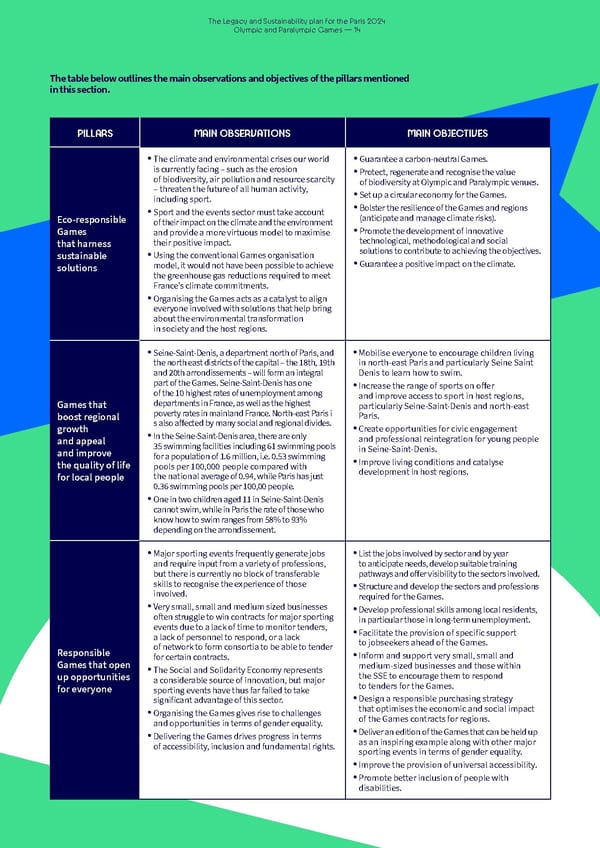
The Legacy and Sustainability plan for the Paris 2024 Olympic and Paralympic Games — 14 The Legacy and Sustainability plan for the Paris 2024 Olympic and Paralympic Games — 14 The table below outlines the main observations and objectives of the pillars mentioned in this section. • The climate and environmental crises our world is currently facing – such as the erosion of biodiversity, air pollution and resource scarcity – threaten the future of all human activity, including sport. • Sport and the events sector must take account of their impact on the climate and the environment and provide a more virtuous model to maximise their positive impact. • Using the conventional Games organisation model, it would not have been possible to achieve the greenhouse gas reductions required to meet France’s climate commitments. • Organising the Games acts as a catalyst to align everyone involved with solutions that help bring about the environmental transformation in society and the host regions. • Seine-Saint-Denis, a department north of Paris, and the north east districts of the capital – the 18th, 19th and 20th arrondissements – will form an integral part of the Games. Seine-Saint-Denis has one of the 10 highest rates of unemployment among departments in France, as well as the highest poverty rates in mainland France. North-east Paris i s also affected by many social and regional divides. • In the Seine-Saint-Denis area, there are only 35 swimming facilities including 61 swimming pools for a population of 1.6 million, i.e. 0.53 swimming pools per 100,000 people compared with the national average of 0.94, while Paris has just 0.36 swimming pools per 100,00 people. • One in two children aged 11 in Seine-Saint-Denis cannot swim, while in Paris the rate of those who know how to swim ranges from 58% to 93% depending on the arrondissement. • Major sporting events frequently generate jobs and require input from a variety of professions, but there is currently no block of transferable skills to recognise the experience of those involved. • Very small, small and medium sized businesses often struggle to win contracts for major sporting events due to a lack of time to monitor tenders, a lack of personnel to respond, or a lack of network to form consortia to be able to tender for certain contracts. • The Social and Solidarity Economy represents a considerable source of innovation, but major sporting events have thus far failed to take significant advantage of this sector. • Organising the Games gives rise to challenges and opportunities in terms of gender equality. • Delivering the Games drives progress in terms of accessibility, inclusion and fundamental rights. • Mobilise everyone to encourage children living in north-east Paris and particularly Seine Saint Denis to learn how to swim. • Increase the range of sports on offer and improve access to sport in host regions, particularly Seine-Saint-Denis and north-east Paris. • Create opportunities for civic engagement and professional reintegration for young people in Seine-Saint-Denis. • Improve living conditions and catalyse development in host regions. • List the jobs involved by sector and by year to anticipate needs, develop suitable training pathways and offer visibility to the sectors involved. • Structure and develop the sectors and professions required for the Games. • Develop professional skills among local residents, in particular those in long-term unemployment. • Facilitate the provision of specific support to jobseekers ahead of the Games. • Inform and support very small, small and medium-sized businesses and those within the SSE to encourage them to respond to tenders for the Games. • Design a responsible purchasing strategy that optimises the economic and social impact of the Games contracts for regions. • Deliver an edition of the Games that can be held up as an inspiring example along with other major sporting events in terms of gender equality. • Improve the provision of universal accessibility. • Promote better inclusion of people with disabilities. • Guarantee a carbon-neutral Games. • Protect, regenerate and recognise the value of biodiversity at Olympic and Paralympic venues. • Set up a circular economy for the Games. • Bolster the resilience of the Games and regions (anticipate and manage climate risks). • Promote the development of innovative technological, methodological and social solutions to contribute to achieving the objectives. • Guarantee a positive impact on the climate. PILLARS MAIN OBSERVATIONS MAIN OBJECTIVES Eco-responsible Games that harness sustainable solutions Games that boost regional growth and appeal and improve the quality of life for local people Responsible Games that open up opportunities for everyone
 Paris24 Legacy and Sustainability Page 13 Page 15